Thursday, March 8, 2012

Losing...and Finding

Hey all,

This is just a brief note to say that production for the University of Manitoba Press' spring titles has recently put a crimp in Lost Foote Photos' style.

If you're curious, UMP's reprints of Jennifer Reid's Louis Riel and the Creation of Modern Canada and Erika Dyck's Psychedelic Psychiatry: LSD on the Canadian Prairies are both available.

The last few weeks have been spent putting the finishing touches on Robin Jarvis Brownlie & Valerie J. Korinek's Finding a Way to the Heart: Feminist Writings on Aboriginal and Women’s History in Canada, which will be due out in April and Larry Krotz' Piecing the Puzzle: The Genesis of AIDS Research in Africa, which will come out in May.

But we've got lots of found photos to share and several favourite Foote photo columns from archivists and artists and historians on the way.

David Carr, U of M Press' director, even has a story to tell about another visit to a small archive where he uncovered Foote photos.

So be patient with us, this week and next, and come back!

Thanks!

Ariel Gordon
UMP Promotions/Editorial Assistant

Monday, March 5, 2012

Countours: Two Visions of Early Winnipeg

As you'll recall, filmmaker Jeff McKay contributed a Favourite Foote Photo to this blog.

In it, he talks about how he and his partner Laszlo Markovics selected photos for what would become the documentary, Contours: Two Visions of Early Winnipeg (2009).


"L.B Foote and L.L. FitzGerald both lived in worked in Winnipeg at the turn of the 20th century when Winnipeg was one of the fastest-growing cities in North America. Foote was a commercial photographer and FitzGerald a painter who often depicted the same scenes, yet they represent two completely different ways of seeing the city they called their home. Both Foote and FitzGerald left a legacy of thousands of evocative images with the city as their muse as they experienced its development first hand."

Jeff was kind enough to allow us to share this clip from Contours, which features a voiceover by historian Doug Smith.

A film by Jeff McKay and Laszlo Markovics
New Projects Inc. © 2009

Thursday, February 23, 2012

Further to Colin Corneau's Favourite Foote Photo

Last week, Brandon-based photographer Colin Corneau wrote about a Foote photo entitled The King and Queen of Siam.

For those of you who might be interested, specifically, they were King Prajadhipok and Queen Rambhai Barni.

According to Wikipedia, Prajadhipok was crowned King of Siam in February 1926 at the age of thirty-two.

He abdicated in 1935 after political turmoil in what was to become Thailand.

This helps to date the Foote photo, as does a similar photo taken in Germany in 1934.

Thanks to UMP director David Carr for the research on Thailand's last absolute monarch!

Wednesday, February 22, 2012

Found Foote Photo #5: Cycles

From Margaret Shaw-MacKinnon, Margaret Shaw's daughter:

"Margaret Shaw, our mom, created Cycles while she was in the Penhandler’s writing group, a Winnipeg women’s writers’ criticism group that was founded in 1940 and that ran until 2010.

Cycles was published in The Penhandler’s Almanac in 1988.

The Penhandler’s group at the time consisted of Helen Norrie, Kay Dalton, Bernice Cunnington, Olive Goldie, Isabel Reimer, Anne Fairley, Marjorie MacDonald, Muriel Leeson, Audrey Peterkin, Betty Dyck, Margaret Shaw, Mary Lile Benham, Anita Schmidt, Lillian Downes, Bess Kaplan, Joan Grenon, Margaret Owen, Beatrice Fines, and Dorothy Garbutt.

I look back fondly to the time when Mom was writing the story and sharing her process with me. She was reading Ann Moray’s A Fair Stream of Silver: Love Tales from Celtic Lore (1965) as part of her story-writing inspiration, and she would read me passages that struck her as particularly moving and lyrical. I had completed my MA in English at the U of M and was busy with Ph.D. coursework. Mom had lost Dad, Dr. E.C. Shaw, back in 1980, and several years later when she was writing Cycles, she could still easily write out of that loss.

A bright light for her and for me was that we were constantly in dialogue over writing matters — including her Cycles story inspired by the family photo she cherished that was taken by Lewis Foote and in which she includes him."

* * *

An excerpt from Cycles by Margaret Shaw:

I coast down the little ravine, then up the other side, keeping up the speed now that I'm on the level. I want to see my mother again...and my father, with his good-natured teasing, and dependable kindness.

Past the bridge now, the path splits on the left into the clay-covered 'monkey trails,' which fall sharply down to the edge of the river. On an impulse I turn into one, but misjudge my speed and the slipperiness of the clay, damp in the deep shade, even in this heat.

"Oh!" I yell as the bicycle skids sideways and I fall. Eyes closed, my head is spinning. Then it stops.

Coming back along a hollow passageway, I feel someone patting my hand, as if to waken me.

"Oh!" I cry again. A man, possibly in his late 30s, kneels beside me with a worried expression on his face. He has bright blue eyes, not unlike my own, and is dressed in a plain vest and pants, and a white shirt with a stiffly starched collar. There is something vaguely out-of-date about his clothing.

He smiles, a slightly asymmetrical smile, again like my own.

"You're alright then. That's a relief. You had me worried. I'm afraid you'll be hurting after a fall like that."

"Oh, it doesn't matter."

He smiles encouragingly. "If you're hurting, it matters. But you'll be alright. Time heals, as they say."

He lifts my bicycle and gives me his hand. There is a world of strength in it. As I stand to brush myself off, he says, "You must have come down that path at quite a clip. Whoever taught you how to ride should have taught you how to stop as well."

I can't help smiling. "It's the brakes. I often back-pedal, instead of using my hands."

He is inspecting the hand brakes with interest when a voice calls, "Alistair! We're taking the picture!"

As I turn I see a group of about 20 people, dressed in clothing from the 20s. Laughing and talking, they are arranging themselves for a photograph against a backdrop of trees.

"Are those your friends?"

"Aye, and maybe relatives one day. They're here for a family picture with Lewis Foote, the photographer. That's him with the camera. They want me in the picture but I'm just engaged to one of the daughters - I'm not married yet!"

A craggy-faced man comes out from under the black cover of the tripod, and waves in the direction of the trees.

"I'd better be getting back. You'll be alright now." A statement, yet with a questioning lilt.

"I think so. It's a good thing you came by."

"I wanted to...to let you know that we are here." He indicated with a nod the laughing group on the lawn. An intent look of concern, a smile, and then, "You'll not forget I'm wishing you well."

"No, no," I say. "Thank you."

I don't look at the group again, and their voices still to silence by the time I am at the end of the clay trail and out in the sunshine again.


Back on the main path, I notice the chaotic designs of patches in the asphalt. I walk the bicycle a little farther until the pedal is in the right position for my foot, then ease myself onto the seat and start riding. Gingerly, I test the hand brakes once or twice. Then I pick up speed and feel the fresh air on my face as I head toward home.

Back in the house, I set the keys down on the kitchen counter and start up the stairs to the attic. In a large dust-sprinkled cardboard box, I find a stack of old albums, and open one to a dimly-remembered family group. They have been interrupted at a picnic, as my cousins have baseball bats and a soccer ball in front of them. Smiling, loving faces - aunts and uncles, one after another, Grandma and Grandpa as the heads of the clan, cousins' young faces showing traces of their adult features. Mother with bobbed hair, graceful in her chemise dress and buttoned pumps, calm eyes looking at the camera.

Father isn't there.

I study the photograph for a long time, and then gently close the page and put the book away.

Found Foote Photo #5: Picnic in Assiniboine Forest, 1923

"The McLean family was very proud to have a photo taken by L.B. Foote.

Our grandmother, Janet McLean (second from the left in the middle row), came to Canada in 1912. When this family photo was taken at Assiniboine Park, she was engaged to our grandfather, Alexander Munro. Our grandfather, who was at this family get-together, was asked to join the family photo. However, he felt that since he hadn't officially joined the family through marriage yet, he shouldn't be included in the photo. Our grandparents married in the 1920s. Our mother, Margaret, was born in 1929.

John and Norman McLean (far left and far right, back row) came to Canada in 1911 to work for a newspaper in Regina. They left Regina to purchase a newspaper in Transcona. Originally the paper was called the Transcona Times. Later, they became the founders of The Elmwood Herald.

The rest of the family moved from Scotland to Transcona in 1912. The other two brothers, Robert and Archibald (far right and far left, middle row), worked at the Transcona Times. Our grandmother was a stenographer and her sister, Margaret (second from the right, back row), was a clerk for the CNR. Our great-grandfather, John McLean (third from right, back row), also worked for the CNR. Both Archie and Robert served during the First World War in France as did our grandfather, Alex."

Submitted by the family of Margaret and Ed Shaw:
Janet, Sandra, Margaret, Ed, and Irene

* * *

Thanks to Janet Shaw-Russell for sharing both this photo and the story behind the photo!

Friday, February 17, 2012

Favourite Foote Photos: Bob Lower

I spent much of the 1970s haunting the Manitoba Archives Photo Collection. As a filmmaker I rarely finish a film without an historical sequence, so through the years I looked at every snap in the drawers, most more than once. Then one day, the photos started haunting me. Specifically, one group of photos and of that one particular image, but I’ll get to that.

When the Foote Collection first showed up it was breathtaking, and not just for the obvious reasons. What made it really special was the quality of the prints. Foote used 8x10 glass negatives for much of his career and the archivists, bless their hearts, made contact 8x10 prints from them, several for each, which were put into the folders for purchase by any passing researcher. Their clarity and immediacy were and are stunning. I couldn’t resist several of these and I still have them. One of my favourites is “Fred Ferguson and his son – 1928.” Father and son stand beside a little Aeronca monoplane and the boy’s proud glee evokes so much of my own plane-crazy childhood, he makes me laugh.

The one that haunts me, however, I haven’t seen for 35 years and more. I found it among Foote’s photos for the coroner, a sad and sordid record of violent and accidental deaths through the decades. Several made me curious about the stories behind them, but one group wouldn’t leave me alone. I think they were from 1930 or 31 and perhaps taken in April, but it could have been late fall. They record a multiple murder-suicide in a poverty-shack farmhouse on a patch of bald prairie...somewhere. The farmer has shot his family and himself. All the images are terribly disturbing but one stands out. It is the thinly clothed body of an unidentifiable woman huddled on the ground many yards from the house. Whether he chased her and killed her there or she crawled out and died of wounds or exposure is unclear but several things about the photo make it unforgettable.

First there is the spot itself. What a lonely, cheerless, exposed spot to spend her last minutes - maybe hours. Hard dry stubble, freezing ground, no shelter from icy wind or stalking brute. Did she lie out here listening to her family die one by one? Or was it all over then but her own slow demise? How awful were her memories if what they led toward was this? What guilt did she feel for her children’s fate? Did she hope and pray for help or had all reason to live left her?

And then there is one more detail in the picture, an element that gives the scene a whole other dimension: in the background of that shot is a car that I remember as a Ford Model A. No other cars or people, just a depression-era sedan stopped in the middle of nowhere.

There is no hint of living presence in any of the photos except this. Suddenly you are aware of another layer of bleak activity taking place. Foote’s assistant, police, coroner’s men, perhaps a neighbour, all digesting this horror first hand out on the chilly, silent prairie, each in his own way aware that this could be his life, his family - or strenuously holding such awareness at bay. And Foote, fastidiously recording every detail on another glass plate.

After about the third time I had reason to be in that collection and found myself riveted, I decided I should have that photo. Along with several others (I seem to recall a group of Tribune delivery boys going to a movie) I put it in my car while I did some downtown shopping. When I came back they were gone. I’ve forgotten the rest after all these years, but I’ve never forgotten that one.

Unless I made the whole thing up.

- Bob Lower


* * *
Bob Lower has been writing, editing and directing films in Winnipeg since 1971, and as such is a walking history of the Winnipeg film community. Drama, documentary, commercials - you name it, he’s got the scars. He is currently working on a film about the National Film Board during the Second World War.

Thursday, February 16, 2012

Found Foote Photo #4: Regalia!

As was mentioned in the previous post, in addition to her Foote photo Joan Lyons brought in a few pieces of her grandfather’s AOF ensemble: a medal and a ribbon that proclaimed that he belonged to Court Excelsior, No. 6898.

Interestingly, the teal ribbon could be turned over to reveal a black version, presumably for attending funeral services when a fellow member died.

Sewn between the two ribbons was piece of cardboard printed with the following:

Jas. C. McQuade
Society Regalia

Badges Banners Seals Stamps Etc.

Manton Block
Winnipeg, Manitoba


It seems surprising that a business could exist solely on the basis of selling regalia for fraternal and friendly societies...until you read biographies from that era.

For instance, Winnipeg’s Frederick McArthur, who was a lawyer and a member of the AOF from the same era, had the following affiliations:

“He was a member of the Ancient Free & Accepted Masons (Past Supreme Master at Arms, Ancient Landmark Lodge), Knights of Pythias (Supreme Representative), Knights of the Maccabees, Ancient Order of Foresters, Woodmen of the World, SOS, Modern Woodmen of America, and Baptist Church.”

Thanks to the Manitoba Historical Society for McArthur’s biography!

Found Foote Photo #4: Ancient Order of Foresters

Winnipeg's Joan Lyons brought in an altogether fascinating collection of items that centered around a Foote photo of the Winnipeg 'court' of the Ancient Order of Foresters.

As we sat down in the St John's College cafeteria, she explained that her maternal grandfather, Timothy James Webster, is the gentleman on the extreme right of the image.

The photo is 12” X 14” and “Foote Photo. Wpg.” is written the photo just under Timothy’s feet. Joan inherited the framed photo and had it archivally re-framed a few years ago.

Timothy Webster came to Canada from England in 1905. He worked as a tinsmith for the CNR and brought his wife Edith and their two children to Winnipeg in 1906.

Eventually, he heard about available farmland in rural Manitoba. The family moved to Ashern in 1910, where Timothy started a mixed farm and eventually become Reeve. He and Edith had seven children, the last of which was born in 1920.

The farm was sold in the 40s and Timothy died in 1956 but the family still has a cottage in Ashern.

But between 1905 and 1910, when Timothy was still in Winnipeg, he joined the Ancient Order of Foresters. Given that the AOF originated in England, Joan thinks that her grandfather may have been a member before immigrating to Canada.

According to the Foresters Friendly Society, the modern incarnation of the AOF, the Ancient Order of Foresters

“seems at first to have been a purely sociable society until the members decided that they had a duty to assist their fellow men who fell into need ‘as they walked through the forests of life’. This 'need' arose principally when a breadwinner fell ill, could not work and, therefore, received no wages. Illness and death left families financially distressed and often destitute. Relief of this need has been the main purpose of the Foresters throughout their long history. It was achieved by members paying, initially, a few pence a week into a common fund from which sick pay and funeral grants could be drawn.”

It's sort of hard to reconcile the elaborate costumes, the medals on their chests and the plumes in their hats, with the very practical - and probably much-needed - social safety net that these kinds of groups offered their members.

But you have to remember that for men like Timothy Webster, these groups offered a chance to meet other recent British immigrants, men who had similar backgrounds. And there's nothing wrong with a little pomp and circumstance every now and then.

Thanks to Joan for sitting in the SJC cafeteria with me, sipping tea and sharing the story of her photo!

UPDATE: According to Esyllt Jones, the award-winning U of M historian who will select and also introduce the photos used in UMP's Foote book, Foote worked "as a recruiter for the Order of Foresters, playing his autoharp and hosting entertainment all along the south shore of Nova Scotia, encouraging people to join the Order." This would have been early in his career, somewhere between 1891 and 1902.

Tuesday, February 14, 2012

Favourite Foote Photos: Colin Corneau

It doesn't take too many viewings of LB Foote's work to realize he was an unique soul.

The well-honed sense of the absurd he clearly possessed came through in such surreal images as a toddler and a bulldog standing atop a pile of ammunition, a banquet being held - for some unknown reason - in an ornate underground sewer, or a severed horse's head staring lifelessly up to the heavens.

Also notable were his many acts of daring, such as his high-altitude photographs from atop the newly constructed Hotel Fort Garry or the shot of the Eaton's building being raised. Speaking from personal experience, these are nerve-wracking moments but to do so with the limitations of the camera technology he had at that time is simply astounding.

However, one image I keep coming back to is his relatively straightforward photograph of the "King and Queen of Siam."

Photographs made with the limited technology of the time often needed much more time to set up and longer exposures. This made candid photography challenging, if not impossible. So, when subtle details on the part of subjects shows through, it's more than luck - it speaks to the skill and insight of the photographer.

In this image, we see a range of expressions and moments that, taken together, tell an interesting story (maybe enough for a great story, novel or movie). On the face of the King we see a bemused expression, perhaps smiling out of duty or perhaps wondering how he ended up in such a strange faraway place.

Beside him, his queen is decidedly less amused. Her pretty features are devoid of any pleasure. One can only speculate, but this may be protocol, it may be gender roles of the time and culture or perhaps weariness at what must have been a long journey.

Flanking the honoured guests on either side are the local dignitaries with the obligatory expressions. I can't imagine why the royal couple of what is now Thailand would come to Winnipeg, but the occasion was clearly an important one and these men would have been entrusted with the impression these exotic foreigners would have of our city.

All about them are fellow passengers or dignitaries, wearing expressions that range from from happiness and pride to stoicism. Of particular note to me was the person at the left, in the background beside the head of the uniformed man, seemingly craning his head to see what's going on or to be included in the event.

It's difficult enough to find such subtleties in quiet, everyday moments. But to do so in the middle of the pomp and circumstance of an 'official' event - not to mention some probable constraints on time - shows a skill not only technically based but with people as well.

- Colin Corneau


* * *
Colin Corneau is a Manitoba photographer with a particular interest in film and analog processes. His photographs of China have been exhibited around the province and he currently documents the people and events of southwestern Manitoba as a staff photographer with the Brandon Sun. His work can be seen at www.colincorneau.com.

Monday, February 13, 2012

Foote note #6

So the University of Manitoba Press does banners for the entry page of its website.

The banners are advertisements for the current season's books, one per book.

It's hard work, boiling down a book to a postcard-sized square, something that will entice visitors to the site to check out that particular book.

Since the summer, it's been my job to create them.

Like Cheryl Miki (UMP's Sales & Marketing Supervisor) before me, I usually use images from the photo sections of the books or, if a book doesn't have a photo section, something that plays off a related visual concept.

Doing a banner for this blog was difficult in that there were SO MANY CHOICES even just considering the photos we've used ON this blog, nevermind the hundreds of images we have scanned for use in the book.

But this photo has stuck with me. There's something about the faces of these babies, how very raw they are, knowing that they're probably dead and gone by now...so I thought I'd try it.

(Which I suppose makes it MY Favourite Foote Photo.)

Having recently watched Jeff McKay's documentary on Foote, I appreciated how he zoomed in on the photos, so I thought I'd use a detail instead of the entire photo. And although you have to be careful with hand-writing fonts, I've been looking at Foote signatures on photos for weeks and WEEKS now and thought it was an interesting element to include.

Ariel Gordon
UMP Promotions/Editorial Assistant

Friday, February 10, 2012

Favourite Foote Photos: Ian McCausland

This image has been widely used as visual shorthand for the flood of immigration in Western Canada. We see it small in textbooks, or Wikipedia entries, but as with all things about our history, once you zoom in and personalize it, it resonates more.

As a photographer here in Winnipeg, I've spent over 20 years looking at our faces, finding the stories.

Zoom in...see the children in the front row: a whole book could be written on the brother and sister in the very front! The warm embrace four rows back, of one friend to another as they set off to that plot of land in the Interlake they've been promised.

I sit here warm and cozy in February and look at the scarves, the furry collars on wool coats, imagine the long train ride and shiver. This being Winnipeg, you probably know someone who's claiming their great-grandpa is that guy holding the box of Harvest bread. Whether it's true or not? Look hard at this photo and you see men who've given up everything to come over to this wild, strange, and cold land and make something better for themselves and their families back home. But you also see hope.

In my mind's eye...I see Foote standing on a rickety wooden luggage wagon, pushed out to the train by a couple of porters. He's under the cloth, focusing a big clunky 4X5 camera on a tripod.

A translator stands in front of the wagon, explaining to all in Ukrainian or German or Hungarian that they all have to have a photo taken to represent the process of immigration for a story in the newspaper and they must stand very still for the exposure.

Foote blows on his bare hands, cold from handling the gear, as he cocks the shutter and pulls the dark slide. Grabbing the cable release he tells the translator it's time. The translator yells louder: this is the time to stand very still and look at the camera. Foote looks out in the sea of faces, gauges when it's time and gently presses the cable release for the 1/2 of a second. Of course that one guy, there is always ONE guy, moves during the exposure. Foote shrugs, no time to do another, he's already late for the next job. He replaces the dark slide and gives the translator a little nod.

As Foote packs up, everyone files past the wagon silently.

I see this photo happening this way, vividly, because I've done big shots like this (in fact, I’m shooting a 240 person group shot this week!). I've also worked with the essentially the same camera, the 4X5.

As well, a few years ago I captured the same moment for the Province of Manitoba, promoting immigration. A family of four from Ghana rather than a sea of white faces, this time at the airport instead of the train station, but in the eyes, the same hope for a better life.

- Ian McCausland


* * *
Ian McCausland has been a commercial photographer in Winnipeg since 1988. He lives in St James with his wife and son. His website is http://www.ian.ca/ and his blog is http://www.ian.mb.ca/.

Thursday, February 9, 2012

Found Foote Photo #3: Retirement Party

The day the Winnipeg Free Press article appeared, a folder was dropped off at UMP.

Inside was an slightly battered 8" X 10" group photo and a cheery blue guide to the eighty-nine people in the photograph.

Ian Park, the Manager of Food Services at St. John's College (where UMP has its office), happened to have the photos in his office.

The photo commemorates the retirement supper of Ian's maternal great-grandfather, W.A. Aldridge. It has the following signature on it: "Jan. 15th 1944, L.B. Foote Photo." It also bears the number "2163."

William Aldridge is the tall man standing against the wall at the back of the photo, or, according to the diagram, #5.

William was the Deputy City Engineer for the City of Winnipeg. We know that he graduated from St. John's College with a BA in 1900, so he was retiring after more than 40 years' service.

According to Ian, William was a Freemason and president, in 1928, of the Association of Professional Engineers and Geoscientists of Manitoba. He also played the trumpet and followed Winnipeg's jazz scene.

Interestingly, according to this Manitoba Historical Society article, William was a diarist. But not of his personal doings: he kept a record of flood information.

Here's a quote from William D. Hurst, who became City Engineer in 1944:

"In 1896, Mr. William Aldridge commenced to draw a graph of river elevations for each spring break-up and he continued this practice until his retirement as Deputy City Engineer in 1945. Commencing in 1922, he added a diary narrative to each year's break-up as well as the drawing of the hydrograph."

Although he retired in 1944/5, William lived to the age of 103. Ian was 20 when he died and remembers him clearly...

We were initially confused by the chart that came with the photo. It would have taken Foote at least three times as much time to compile the names of all the people in the photograph than it would to TAKE the photo.

Ian explained that his great-grandfather had drawn up the diagram himself, which given his engineering background, made sense. William was very likely to have had scrap blueprint paper in his possession as well as the inclination to want to label all 89 invitees to his dinner.

Thanks to Ian for sharing this photo!

Tuesday, February 7, 2012

Favourite Foote Photos: John Paskievich

One of my favourite Foote photographs is the one of Princess Elizabeth, now Queen, taken in 1951 on the sidewalk in front of the Canadian Pacific Railway Station and the conjoined Royal Alexandra Hotel on Higgins Ave.

My reasons for especially liking this picture are two-fold; the first is nostalgic and the other is photographic.

Arriving with my family in Winnipeg in 1958 I remember us walking out of the CP station and then heading right on Higgins towards Main St. along the same strip of sidewalk where the photo was taken. However, I can't recall any crowds across the street atop Segal Drugs welcoming our arrival.

Growing up in Point Douglas, my friends and I would spend our Saturdays at one of the many movie theatres that lined Main St. from Higgins to Alexander Ave. To get to Main St. we would often take a short cut through the CP Station and Royal Alec via a little known back entrance located at the foot of Austin St. When we were older we shot pool and got educated in various subjects at the billiards hall in the rear end of the Princess Hotel which was located at about where the Alberta sign is in the Foote picture. I'm wondering if the Princess Hotel was formerly called the Alberta?

The photography that Foote did in the early part of the past century was in the formalist tradition of the time. The subjects were placed firmly in the centre of the frame and looked directly at the lens. The bulky cameras and individual large negatives with slow emulsions weren't conducive to spontaneity either in the photographer or the subject. The more candid shots that Foote took of parades, outdoor celebrations and, most famously, the Winnipeg 1919 Strike were done from a distance where the camera, mounted on a tripod, could be methodically operated with the most efficiency.

When Foote photographed Princess Elizabeth he was at the end of his illustrious career. By then cameras were smaller and films were faster, allowing for more spontaneous photography. Foote's photo of Elizabeth is thoroughly modern in its fortuitous and dynamic arrangement of triangles. The princess and the two uniformed men lead the viewer's eye past the spectators in the roof to the billboard while the motorcade, overhead wires and the drugstore recede into the right side of the frame. Elizabeth's legs, crossed at the ankles, form a delicate triangle that neatly punctuates the picture.

The photograph has the look of a somewhat surreal collage. The princess's posture is so perfectly elegant that it looks like it may have been posed and shot elsewhere and then cut and pasted onto the street scene in Winnipeg. Not knowing who else might be inside the car with the open door and wondering who or what outside the left side of the frame elicited such a lustrous smile from the Princess adds a fine anticipatory tension to the picture.

- John Paskievich


* * *
John Paskievich is a Winnipeg photographer and filmmaker who has yet to get over the savaging of Portage Ave and North Main Street.

Sunday, February 5, 2012

His Most Famous Picture


* * *

From an full-page spread by Bill MacPherson in the Winnipeg Tribune on Saturday, May 15, 1954. Clipping courtesy of the Foote Collection at the Archives of Manitoba.

Friday, February 3, 2012

Favourite Foote Photos: Bryan Scott

Winnipeg has never looked more glorious than it does in the photographs of L.B. Foote.

Capturing image after image of the city at its economic zenith, Foote's archive is a treasure trove, providing a bittersweet glimpse into a Winnipeg that has been lost for decades.

My favorite Foote photo is perhaps a wide angle shot of the 1939 royal procession at the SE corner of Main and Higgins.

The high energy of the period is captured with incredible clarity in the sea of curious royal onlookers, as well as the meticulous and ornate signage that decorates every storefront in the frame.

Even the dampened streets add to the intrigue of the scene, reinforcing the notion that Winnipeg was, once upon a time, a gleaming centre of commerce, industry, and glamour. Foote's Winnipeg is as photogenic as any city in the world.

Significantly, little of the architecture in the frame remains today.

Decimated by good intentions in the name of urban renewal (arguably falling short of the mark), all that's left of the dynamism and joy of the corner is Foote's haunting, timeless photograph.

-Bryan Scott


* * *
Bryan Scott is a Winnipeg-born photographer and graphic designer. His website winnipeglovehate.com features daily photos of the city's good, bad, and sometimes ugly sides. In 2010 he self-published a book version of the blog, Winnipeg Love Hate: Selected Photographs.

Tuesday, January 31, 2012

Foote notes #5

We were contacted last week by one of the retired firefighters that runs the Fire Fighters Museum of Winnipeg, Manitoba, Canada.

In his message, George mentioned that they had some Foote photos in their archive and that we were welcome to come visit and rifle through the thousands of photographs they had in their collection.

UMP director David Carr and I made a trip to the museum first thing this morning.

"Rule 86, boys..." George said, when he led us past the group of retired firemen sitting over coffee in the museum's kitchen. Which apparently means 'no swearing.'

And as George was giving us a tour of former fire station's framed pictures, restored apparatus, and uniforms, again I saw a Foote I'd never seen before.

Make that a couple of surprising Footes.

The first was a portrait of the members of the 1910 City of Winnipeg Fire Department. Producing this image would have involved dozens of studio portraits, someone to create the template to set the images in, and someone to assemble the entire puzzle.

I would have doubted that it was a Foote...but there was a version of his signature in the left-hand corner.

George said that this image used to hang in every fire station in the city and that the Fire Fighters Museum had three in their archive.

The other surprise of the day wasn't around format but subject: Foote photos of 'volunteer' firemen from the Committee of 1,000 during the 1919 Winnipeg General Strike.

We found three photos in this sequence, mostly of suited men in raincoats perched on apparatus. They look like little boys playing dress-up, like they're having a great adventure, but I wonder what their faces would have looked like if they'd had to attend a fire?

But I digress...

To sum, in addition to the differently-sized photos we've been seeing, now we know there are collage/composite group photos (what do you even call these things?)...and postcards (!)(more on that in the next edition of Foote notes).

The rule of thumb, identification-wise, remains the same: look for a signature on the photo itself, a stamp on the back, or his embossed signature on the matting that surrounds the image.

Ariel Gordon
UMP Promotions/Editorial Assistant

Monday, January 30, 2012

Favourite Foote Photos: Gerry Kopelow

This feels like the right moment to publicly reveal a secret I've carried for 62 years: I am, In Fact, L.B. Foote, reincarnated, right here, right now, back in my Beloved Winnipeg.

I chose the late 20th Century to come back because I was waiting for technology to develop to the point where I could carry on my exquisite obsession with photography of this very unusual city sans all that heavy, bulky, slow hardware I dutifully lugged around all those years through the unrelenting Prairie snow, mud, rain, dust, and wind.

Digital imaging is truly a gift from the Gods of Art.

All that being said, I am very pleased and proud to see my earlier work - originally produced under such difficult conditions - so respectfully preserved and presented.

I love photography, and I love all those images.

Every one of them tugs at my heart, stirring up Poignant Memories of people and situations of Great Interest to me and I hope all Manitobans.

Winnipeg and its inhabitants manifest a strange and wonderful creative energy which I found - and in my current life, continue to find - endlessly fascinating.

These archival works are my gift to my people, and my culture.

I submit a most sincere Thank You to everyone at University of Manitoba Press for the professionalism and kindness embodied in this undertaking.

Best Regards,
L. B. Foote
(a.k.a. Gerry Kopelow)


* * *
Gerry Kopelow is a widely published veteran photographer with extensive experience in advertising illustration, executive portraiture, editorial illustration, architectural photography, and photography of the performing arts.

Friday, January 27, 2012

Favourite Foote Photos: Steven Stothers

I've lived in Winnipeg all my life, and like all of us, I've come across a few of Foote's photos in random places around the city such as the Forks, Union Station, and the Hotel Fort Garry.

I became involved in 2008 in the restoration of Streetcar 356, and also in the history of Winnipeg's streetcars. I knew about Foote's famous 1919 streetcar strike photo and started wondering how many other pictures might be available at the Manitoba Archives and the history of the man himself.

I made a trip to the archives in early 2010 for streetcar research and I made sure to spend some time going through the Foote collection. However, once I started going through his photos, I realized I needed a couple of days to go through them all. The ones on display in public places were clearly just a very small sample of the quality and quantity of his work. I was amazed and intrigued.

This photograph leaped out at me, with the gleaming streetlights shining on the streetcar railtracks and no cars or people around. This was when Memorial Boulevard was called "the mall," and the Winnipeg Art Gallery was in the distant future. Streetcar wires are visible above the tracks, the Bay with its window awnings retracted on the left, there's a small island in the middle, and a house is on the far right.

I'm sure the streetcar rails are still under the pavement waiting to be uncovered again.

Foote must have planned this and waited for the perfect night to get this photo, and I would love to know what time this was actually taken, maybe 2 or 3am?

- Steven Stothers


* * *
Steven Stothers is a sales director for a local software company. He is a life-long Winnipegger with a passion for the history of the city. Steven is co-chair of the restoration of Streetcar 356 project with Heritage Winnipeg, a photographer, and self-published a book in 2005, Somewhere in France, the Letters of John Cannon Stothers.

Thursday, January 26, 2012

Foote notes #4

My sole exposure to L.B. Foote's photos is via the prints at the Archives of Manitoba. To refresh your memory, these are the prints that Foote had in his possession when he died...and they're all 8" X 10" prints.

A few weeks ago, I was able to spend a few hours digging through the Winnipeg Free Press' photo archives with staff photographer Michael Deal and the resident librarians.

In addition to the photos the librarians located for us, we also unearthed a few more photos...and they were all 8" X 10" prints.

None of the images, to my recollection, were taken in a studio. The standard line is that Foote was more interested in shooting anything and everything out in the world than staying the studio and doing portraits.

Remember, Foote had a sales background before he ever picked up a camera.

Foote was the consummate freelancer, a hustler, which is reflected in the range of his subjects and of his clients: from news photography for the Winnipeg Free Press to crime scene photos for the Medical Examiner's Office, to documentary photos for Claydon Brothers Construction.

So you can imagine my shock when, in response to UMP's appeal for Foote photos, we started to see differently-sized images, some of which were clearly shot in a studio.

I've included a sample of these images here, described from top left and then moving clockwise:

Nancy Gates brought in this large image of King Edward VIII at Delta Marsh. The image is approximately 18 1/2" X 14" and is glued to a larger piece of cardboard, which was then framed. I won't say much more about this image, because I'll be doing a Found Foote Photo entry on it, but it is interesting to note that while the picture was shot in 1919, this print wasn't made until 1936...

Marjorie Dawson brought in a photo, shot circa 1912, of her father Oscar John Gottfred in a bike race. The image, 8" X 6 1/8", is glued on a matte frame with a logo reading "L.B. Foote 284 Main Street" to the bottom right. In addition, the photo itself has "Foote Photo" written on the left hand corner.

The third image is courtesy of June Sanderson, whose father is somewhere in the picture, taken some time in the 1920s. It is a long narrow image, 9 1/2" X 5 1/8" in size, and is glued on an plain grey board.

There is no logo or stamp, but the photo has "Foote Photo" in the left hand corner. Interestingly, though it is a different hand, the the placement is the same as the earlier picture of Oscar Gottfred. (You'll remember from Foote notes #1 that it is much more common to see Foote's 'signature' on the right hand side...)

Finally, Vicki Wallace emailed a studio picture of her maternal grandfather, George Edward Boxshall, and his family taken circa 1923. Given that the image was sent via email, I don't know it's precise dimensions, but the photo is in an ornate grey matte frame that includes the text: "Foote and James Winnipeg."

To sum, three weeks ago, I would have sworn up and down that a typical Foote photo was 8" X 10", but clearly if you were a private individual buying a copy of a group photo or commissioning one of your family, Foote gave you a lot of options...

* * *

Thanks to everyone that's shared their images with us! Please don't hesitate to contact us if you've got Foote photos in your private collections...

Ariel Gordon
UMP Promotions/Editorial Assistant

Tuesday, January 24, 2012

Favourite Foote Photos: David Carr

It's almost impossible to pick just one Foote photograph to write about.

Foote had an enormous and diverse range and any single photo seems to ignore the many other themes and styles that weave through his fifty years of photo taking.

Chose one of the great historical images (the North End slum photos for instance) and you seem to forget about the beautifully glossy portraits, such as the young Duke of Windsor standing, looking quite bored, next to a brilliantly polished black locomotive. Chose one of the portraits, and you‘re missing the powerful emotive images of ‘everyday’ family and private life.

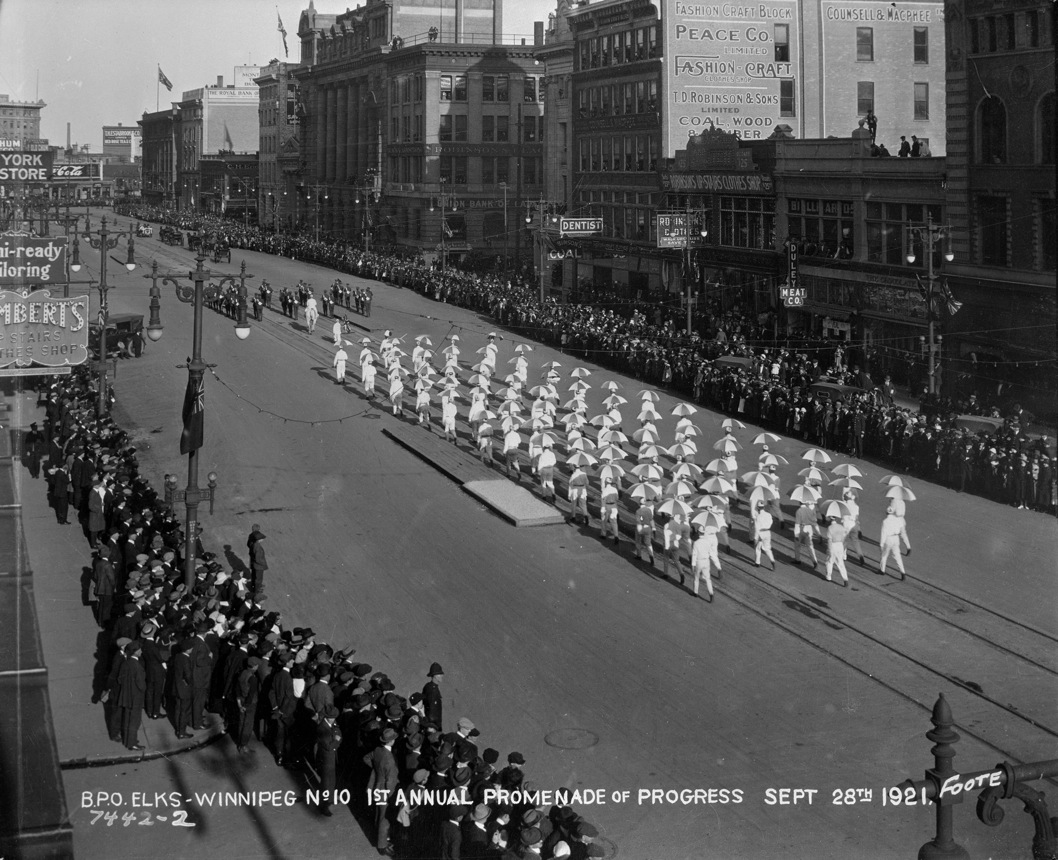
I’ve chosen a photo that doesn’t seem to have any of these characteristics. It’s a long, overhead shot of the Elks (Winnipeg Lodge No. 10) marching up Main Street as part of something called “The Promenade of Progress.” “Marching” is perhaps not the right way to describe a group of men dressed in white pants and beanies carrying striped umbrellas at the end of September, although its probably unfair to call it “sashaying” either. It is, nevertheless, one of those strikingly incongruous images that run through Foote’s work.

It is this kind of photo, like the banquet in the sewer or the crew tasting the ice on the Red River, that always makes Foote seem like the artistic grandfather of Guy Maddin. What in the world could these men, dressed for some sort of odd Sunday outing, have to do with anyone’s idea of “progress?”

But the date and place put this strange little parade into another context. The “Promenade” took place September 28, 1921. Just a little more than two years before, only a few hundred feet further north on Main Street, Winnipeg’s working class had tried its hand at a very different and much more serious movement towards progress. No one, of course, would have know this better than Foote himself, who had famously recorded those events of the 1919 General Strike in very nearly the same spot.

Throughout the first part of the last century, this stretch of Main Street between the CNR Station and City Hall was the city’s ceremonial centre, certainly as chronicled by Foote himself. Every type of parade or procession went this route, and it may be adding too much symbolic weight to the crossing paths on Main Street of the strikers and the Elks. Nevertheless, its hard not to think that striped umbrellas and beanies in tight formation are exactly what Winnipeg’s city fathers thought was just what was needed to help erase memories of those nasty events two years before. And L.B. Foote was, as always, there to record it.

Elks at the Promenade of Progress, September 1921

* * *

David Carr
is the director of the University of Manitoba Press.

Monday, January 23, 2012

Found Photo #1: Sacred Heart Parish Church

This email arrived in my inbox the day the article appeared in the Winnipeg Free Press:

"Hello, here is a scan of a Foote photo.

The image is of the altar boys of the former Belgian Sacred Heart Parish Church in St Boniface. The parish was located at 501 Plinquet Street in St. Boniface from 1917 until 1993. This photo was taken about 1920.

People in the photo:

1. Henry Van Elslander - he went on to be the first priest ordained from western Canada for the Belgian Capuchin Fathers.

2. John Van Buckenhout - born in 1908.

3. Father E. Kwakman - first priest of the parish from 1917-1928.

4. Jos. Verschaere

I was given the photo a few years ago from the daughter of John Van Buckenhout. Miss Louise Van Buckenhout was getting rid of things at the time.

I have no particular interest in old photos, I don’t collect them. I went to that church."

- Neil Pryce

Friday, January 20, 2012

Favourite Foote Photos: Janis Thiessen

How to choose only one favourite from the Foote collection? For those of us who love both history and this city, doing so is a challenge indeed.

This well-known photo of workers copper sheathing the roof of the Hotel Fort Garry circa 1915 has been one of my favourites for a long time. (I use it on my website’s homepage and as my Facebook profile photo.)

The skilled labour that is so often taken for granted is here visible, captured in a moment that might have similarly occurred four years earlier in the construction of the Union Station depicted in the photo’s background, and five years later at the Legislature a few blocks away.

Like the photos of the Winnipeg General Strike that Foote would later take, this picture of workers pausing to pose in the midst of their labour provokes questions about the nature of labour relations. Would such workers ever have had the opportunity to have a drink in the hotel’s beautifully ornate Palm Room to celebrate the end of a successful job? Did those who brokered business deals in the Palm Room ever contemplate the hands and minds that built their surroundings?

Winnipeg stretches away to the east in the photo’s background, and the working men atop the hotel’s roof look as though they are, at least temporarily, the ‘kings of the castle.’ Whatever challenges their working conditions, their relations with their employers, and their economic circumstances may have presented, Foote’s camera here elevates these workers to positions of honour. Foote has captured a moment in time that reminds us that our city was built – in more than just a literal sense – by workers like these.

- Janis Thiessen


* * *
Janis Thiessen is an assistant professor of history at the University of Winnipeg. Her first book, Manufacturing Mennonites: Work and Religion in Post-War Manitoba, will be available from University of Toronto Press in June of this year.

Thursday, January 19, 2012

Foote notes #3

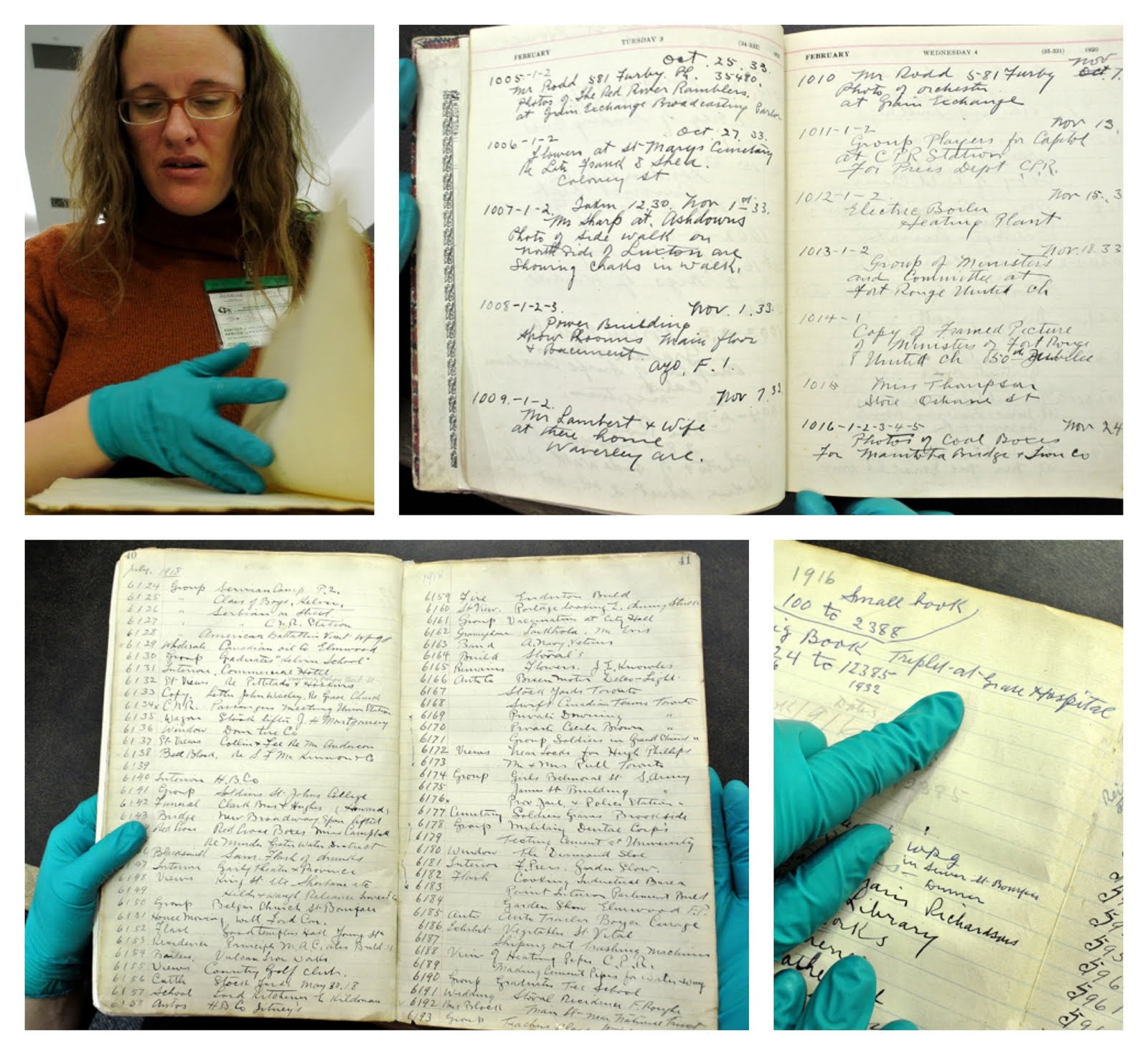
In my previous posts on identifying Foote photos, I was blithering on about Foote's ledgers, so I thought I'd share a few images of them.

UMP director David Carr and I visited the Manitoba Archives back in November and donned surgical gloves in order to look at Foote's ledgers, diaries, clippings...and, of course, the filing cabinets full of his photographs.

(Winnipeg Free Press photographer Mike Deal accompanied us and took a few photographs of the ledgers, which he's let us use...)

Though we just leafed through the ledgers randomly, we were able to find the entry for one of the photos we've posted to this blog, of a nurse holding three swaddled babies.

The Archives attached the following description to the photo: "Major Mrs. Louise Payne with triplets, 1916." In their numbering system, it is officially described as "n2489."

Foote described it as "Triplet at Grace Hospital" and while it somewhat unclear in this particular entry, it seems to occupy the space between 5915 and 5916 in the ledger.

Finally, the photo itself has numbers inscribed on the image's top left. They seem to be backwards...and don't seem to correspond with the ledger number. (5-816?)

It was highly interesting to see Foote's filing system, such as it may be. (Can you imagine keeping track of fifty years' worth of photographs? I can't.)

Ariel Gordon
UMP Promotions/Editorial Assistant

Wednesday, January 18, 2012

Found Foote Photo #2: Claydon Bro's CONTINUED


Norman Claydon, the grandson of the founders of Claydon Brothers Contractors, shared this photo with us. He started at Claydon as as labourer and ended as secretary-treasurer.

The company closed its doors in approx. 1971.

* * *

From the City of Winnipeg's Historical Buildings Committee report on 626 Wardlaw Avenue:

"Claydon Brothers was founded in 1904 by Ebenezer (1881-1954) and Arthur Claydon, two of the five Claydon brothers. Ebenezer Claydon was born in Deeping St. James, Lincolnshire, England in 1881. After receiving his education in England, he immigrated to Canada in 1902, coming to Winnipeg shortly thereafter and establishing the general contracting firm Claydon Brothers in 1904. During his career, Ebenezer Claydon was also president of the Winnipeg Builders Exchange and vice-president of the Canadian Construction Association.

A third brother, Ernest, came to Winnipeg and joined the firm ca.1912. Arthur and Ernest enlisted and fought overseas during World War I and Arthur was killed in action in 1917. Ernest returned to Winnipeg and rejoined Claydon Brothers as the secretary-treasurer, with Ebenezer as president.

The firm was reorganized in 1917 and renamed Claydon Company Limited. By 1945, it had been expanded to handle home and business fuels and to include five Claydons: Ebenezer; his two sons, Oliver and Gurth E.; and Ernest and his son Rowland. Ebenezer died on February 26, 1954 and Ernest died in 1976. J. Norman Claydon, a son of Gurth E., was also associated with the business in the 1970s and continues to live in the city.

Like other medium-scale contracting firms, Claydon Brothers also designed and owned some of the structures they built, usually single-family dwellings. All of Winnipeg's important early twentieth-century architects used this firm. Some of its better known and larger projects include:

Broadway Baptist Church, Broadway (1906 and 1914 addition)
Dominion Bank, 678 Main Street (1907)
Church of Christ, Sherbrook Street (1907)
Canadian Pacific Railway Immigration Office, Maple Street (1907)
Assiniboine Park, first Pavilion (1908)
Windermere Apartments, 224 Kennedy Street (1909)
Kennedy Building, 317 Portage Avenue (1909)
Havergal Ladies' College, 122 Carlton Street (major renovations, 1909)
Kenilworth Court Apartments, 44 Hargrave Street (1910)
St. Elmo Apartments, 177 Colony Street (1910)
W.J. Christie House, 365 Wellington Crescent (1910)
Ackland and Son Limited Warehouse, 67 Higgins Avenue (1911)
DeBary (Highgate) Apartments, 626 Wardlaw Avenue (1912)
Anvers Apartments, 758 McMillan Avenue (1912)
Brussels Apartments, 150-56 Lilac Street (1912)
Brown Block, 902 Home Street (1912)
W.A. Hossie House, 66 Waterloo Street (1913)
Sunnycrest Apartments, 667 Wolseley Avenue (1913)
William Whyte School, Powers Street (1913)
King George Hospital, 1 Morley Avenue (completed 1914)
City Light and Power, Terminal Station, McFarlane Street (1918)
St. Michael and All Angels Anglican Church, 300 Hugo Street North (1920)
Lord Selkirk School No. 1, Brazier Street (major renovations, 1921)
Isaac Newton Junior High School, 730 Aberdeen Avenue (1921)
Indian Affairs Industrial School, Edmonton, AB (1923)
T. Eaton's Company Garage, 349 Graham Avenue (1926)
T. Eaton's Company Mail Order Building, Graham Avenue (additional storey, 1926)
T. Eaton's Company Warehouse, 130 Galt Avenue (1927)
Princess Elizabeth Hospital, 1 Morley Avenue (completed 1950)"

Tuesday, January 17, 2012

Favourite Foote Photos: Jim Blanchard

This is one of my favourite Foote photos. It catches a group of newspaper employees in what I suppose is the newsroom of The Telegram newspaper in their building which still sits at the corner of Albert and McDermot.

The men are posing a little for Foote, maybe joking with him as someone from the rival daily. The big fellow on the left side of the table seems to be saying something that some of them think is funny.

Some of the others are simply working. Their tools are paper pads and pencils, paste bottles and scissors, the latter on a chain so that everyone can share the same pair. There is phone in the left foreground but other than that there are no signs of modern equipment.

Out of this room came, day after day, a fine newspaper with pages full of well-written, detailed reporting on what was going on in the city and out in the world. The quality of the writing was very high and if you browse through The Telegram - paper copies of The Telegram are still available at the Millennium Library - you'll find very few errors in spelling or grammar.

Many of the men in the picture may have been junior employees, like copy boys, who crowded in to get into the picture. But there are definitely a few ink-stained wretches here, men who look like they have been at it for quite a few years.

It's a lively, happy sort of picture that captures something of who these men really were and that's why I like it.

- Jim Blanchard


* * *
Jim Blanchard is the Head of Reference Services at Elizabeth Dafoe Library at the University of Manitoba. He is the author of two award-winning UMP titles, Winnipeg 19120 (2005) and Winnipeg's Great War: A City Comes of Age (2010). (Both titles included Foote photos.)

Monday, January 16, 2012

Found Foote Photo #2: Claydon Bro's Contractors

I came to work today...and discovered that a manilla envelope had been pushed under my door sometime over the weekend.

I stared at it for a moment, then stepped over it. I hung up my jacket, set down my purse and lunch bag, and reached for the envelope.

On the front was an address label from a Mr. Claydon with a phone number written in pen underneath. A few names had been crossed out where the addressee's name would normally go...and the new label inscribed: "Foote Foto."

My favourite part was that the name had been written vertically and horizontally, with the "F" doing double duty as the beginning of "Foote" and "Foto."

Inside, there was a photo of a construction scene, mounted on cardboard, with an index card taped to the back:
CONSTRUCTION OF WINNIPEG GENERAL HOSPITAL -- 1910.
Showing First Steam Shovel To
Work on General Building
Construction in Winnipeg

CLAYDON COMPANY LIMITED
Winnipeg, Manitoba
More mysterious still was the fact that someone had penciled in a question mark next to "1910."

Now to call Mr. Claydon! And find out the story of the picture...

(A note to my numbering system above: this is the second 'lost' Foote photo we've received. The first was dropped off at our office on Friday by someone who works at St. John's College...but more on that later.)

Ariel Gordon
UMP Promotions/Editorial Assistant

Friday, January 13, 2012

Favourite Foote Photos: Allan Levine

Winnipeg was built by a powerful business elite, mainly born in England, Scotland and Ontario. But in its heyday, during the boom years of the early twentieth century, it was truly transformed by hard-working immigrants, who came from Eastern Europe.

Whether they were Poles, Ukrainians, Russians or Jews who journeyed half way around the world to arrive here, these immigrants gave the city, and specifically the North End where they first resided, its unique character.

The culture, food and dress, and multi-ethnic flavour we today associate with the city were derived from this collective experience.

As this early Foote photograph shows, life for the newcomers was extremely difficult and fraught with the various urban problems that defined the pre-First World War era in many North American cities like Winnipeg.

Poverty, disease and hunger in the slums were rampant and Foote brilliantly captured this sense of despair.

Here you have a group of East Europeans, fathers, brothers and their children - and the absence of women is curious - looking tired and disheveled. The men appear as if they have just arrived home from a long day at the factory or working on a road gang and the children from playing in the dirty streets.

When I have written fictional accounts of early Winnipeg, I have closely studied such photographs taken by Foote in an attempt to get inside the head of the city's East European immigrants.

I always liked this one as depicting the trials of their lives: the clothes hanging on the rope, the ray of light in an otherwise dark and dank space, and the empty stares of the men and even the two older girls. They seem to have surrendered to the harsh realities of their ordeal, though the optimistic side of me thinks that they survived and ultimately prospered.


* * *
Allan Levine is a Winnipeg-based historian and the author of the Sam Klein Mystery trilogy set in the city's early twentieth century. His most recent book is William Lyon Mackenzie King: A Life Guided By The Hand Of Destiny.

Thursday, January 12, 2012

Reprint: Point of View

Photographer L. B. Foote documented Winnipeg's early life

Winnipeg Free Press - ON-LINE EDITION
by: Winnipeg Free Press Photo Desk


Legendary Winnipeg photographer L. B. Foote photographed everything from the construction of the Manitoba Legislative Building to parades, accidents and everyday life on the streets during the city's boom town years.

Here are a few images from the Winnipeg Free Press library and the Manitoba Archives.

Click here to see the WFP slideshow of Foote photographs.

Reprint: Foote Prints

Photographer made an impact with iconic images, now U of M Press plans to publish his photos in a book

Winnipeg Free Press - PRINT EDITION
by: Alison Mayes


January is a popular month for de-cluttering. But editors at the University of Manitoba Press are hoping to stop Winnipeggers from tossing out tattered photo albums or musty shoeboxes of old black-and-white photos.

They're asking residents to dig through family and organizational archives in hopes of recovering lost images by L.B. Foote, the pre-eminent photographer of early 20th-century Winnipeg.

They'd also be delighted if anyone dug up correspondence with Foote or even receipts for his services, since the textual record of his life is slim.

This fall, the press plans to publish a book of photos by the self-taught, highly skilled Foote, who lived from 1873 to 1957. The adventurous Newfoundlander born Lewis Benjamin arrived here in 1902 and captured thousands of images during a freelance career spanning more than four decades.

Since the Manitoba Archives acquired Foote's personal archive from his family in the early 1970s, his photos have been used in many books, documentaries and museum exhibits.

Foote's rare, compelling images of the 1919 Winnipeg General Strike have attained iconic status, particularly his shot of workers rocking a streetcar on Bloody Saturday.

But his day-in, day-out work was commercial photography. He had a downtown studio, but also worked for at least part of his career from his home on Gertrude Avenue.

For the rest of the article, click here.

Tuesday, January 10, 2012

Favourite Foote Photos: Gordon Goldsborough

On the day after Dominion Day, 1922, seven men gathered in the kitchen at 109 Henry Avenue, a couple of blocks from Winnipeg’s CPR Station.

Among them were 39 year-old Wasyl Spachynski and 49 year-old George Antoniuk.

Tensions were strained between the two men, apparently because Antoniuk railed at Spachynski’s claim to be the “boss of Henry Avenue."

Following a short, heated quarrel, Antoniuk took out a pocket knife and stabbed Spachynski in the neck, severing his jugular vein.

Police called to the scene found Antoniuk standing outside, spattered in blood, and Spachynski on the floor inside.

Rushed to the Winnipeg General Hospital, Spachynski died within five minutes.

It is not well known that, in addition to his work taking portraits and documenting special events, Lewis Foote also worked as a police photographer.

Among the collections at the Archives of Manitoba are grisly photos of corpses and crime scenes, most of which have been taken out of active circulation to dissuade “looky loos."

I like this photo — taken by Foote soon after the crime — because, unlike a lot of his photos, it is unposed and raw, showing us what the kitchen of a low-income household in 1922 Winnipeg looked like.

Aside from the blood stains, rags, and abandoned cigarette pack on the floor, it seems lovingly well-tended, with plates and containers neatly arranged on the cupboard, a towel drying on a line, pots sitting on the small wood stove, and frilly curtains in the window.

Justice for the murdered Spachynski was swift. On 17 November 1922, a jury found Antoniuk guilty of manslaughter and he was sentenced to five years in prison.

Today, the scene of the crime is long gone, the building having fallen during construction of the Disraeli Freeway.

- Gordon Goldsborough

* * *
Gordon Goldsborough is Webmaster, Secretary, and a Past-President of the Manitoba Historical Society, and an editor of Manitoba History journal. He is presently working on an interactive map of historic sites around Manitoba, and is co-authoring a forthcoming book on the environmental history of Delta Marsh. He is also an aquatic ecologist in the Department of Biological Sciences at the University of Manitoba.

Foote on Flickr!

We've shared a dozen or so Foote photographs on this blog, but for those of you that need MORE FOOTE PHOTOS and can't wait until the UMP book is out next fall, there's a set of several hundred photos on Flickr, the photo-sharing website.

I've been linking there in my emails...and the person who owns the set has noticed the upsurge in traffic and has posted 64 more photos.

This is one of the 'new' photos and it's officially my new favourite Foote photo. (I have a new favourite every week, it seems...)

The caption is "Miss Winnipeg 1923." I wonder, can anyone identify our snow-shoeing beauty queen?

Ariel Gordon
UMP Promotions/Editorial Assistant

Monday, January 9, 2012

Foote notes #2

So you've got a photo you're convinced is by L.B. Foote. But it doesn't have his signature, identifying numbers, or stamp (as was described in the first edition of Foote Notes).

If you have the original envelope the photo came in, check to see if there's an invoice or any other documentation.

Foote had different letterhead over the five decades that he was photographing Winnipeg (and invoicing Winnipeggers for same...) and so included with this post is an sample from his Foote & James years and also something mid-career.

Finally, he also sometimes issued a type-written page detailing the photos he took with a ink signature at the bottom, so we're including that here too.

Ariel Gordon
UMP Promotions/Editorial Assistant

Friday, January 6, 2012

Favourite Foote Photos: Danny Schur

My favourite Foote photograph, even more than his iconic tipped streetcar shot from Bloody Saturday, is the famous “Down With Bolshevism” shot from the 1919 Winnipeg General Strike.

The shot was taken on the west side of City Hall, earlier in June, and depicts an anti-strike veterans' parade that culminated at the Gingerbread city hall.

For me, the shot epitomizes so many of the forces at work in Winnipeg society, not just in the First World War, but from the time of Riel.

The exuberance of the Victorian architecture, the Protestant thirst for order and good government (as represented by the British Empire and parliamentary system), virulent xenophobia (if not outright racism) mixed with a preponderance of militarism, a passionate, unruly veteran class (ultimately the wild card in the outcome of the strike) – all are encompassed here with but one click of Foote's documentary camera.

And whether by accident or design, the details of the photograph are exquisite: the mayor clasping his hands to address the crowd, the Union Jack shadowed such that it appears almost 3-D, the surging symmetry of the drain pipe, pole and vertical lines of the gingerbread City Hall – and all balanced by the hat-wearing crowd.

While certainly taken in the heat of the moment, only Foote's great artistic eye could have so composed a spontaneous shot.

- Danny Schur


* * *
Danny Schur is a Winnipeg-based composer/producer/writer/director for stage, screen and radio. Known for his musical Strike! (set against the 1919 Winnipeg General Strike), Danny is working on a new musical about Louis Riel with writing partner Rick Chafe.

Thursday, January 5, 2012

Foote notes #1

So you think you might have a photograph by L.B. Foote but you're not sure...

Well, Foote photos have a few defining characteristics.

First of all, the word "Foote" appears in white on many of his photos, usually to the right hand side with a series of numbers on the left. Though sometimes this signature of sorts appears on the left hand side or in other high-contrast areas of the photograph.

Here are examples of some of his signatures.

You'll note that one of the photo details I've included here says "Foote & James." Those are from early in Foote's career, when he was in business with George James, who apparently did most of the printing.

Also worth noting is that later photos sometimes include a longer signature. For instance, a series of images from V.E. Day 1945 included this signature: "May 7, 1945. L.B. Foote Photo."

Other ways of telling if you have a Foote photo is that he sometimes stamped the back of his prints with the following information: "L.B. Foote 492 Gertrude Ave. Telephone 41968"

If your photo has none of these markings but you're convinced that it's a Foote photo, it is also possible to check the photo against the hand-written ledgers that Foote kept, detailing his clients and a brief description of each photo's subject matter.

The ledgers are at the Archives of Manitoba and do not cover Foote's entire career but...they're better than nothing, especially when you're trying to identify a photograph.

Ariel Gordon
UMP Promotions/Editorial Assistant

Monday, January 2, 2012

Favourite Foote Photos: Jeff McKay

When Laszo Markovics and I were doing our film about L.B. Foote and L.L.FitzGerald we went through hundreds and hundreds of images.

Foote was a commercial photographer but he was had this absolutely out-of-left-field side to his work. He obviously had a real sense of humour, curiousity and theatricality.

Much of his work is so well done, well framed, exposed, executed and there are many photos which spring forth in my mind as favorites.

But this image of the two chickens captured atop a pedestal in front of a lit backdrop at the poultry show is a standout for me.

When I see it I think of the speed in which he worked with the equipment he had at the time.

Glass plates, exposures, and he did a lot of the printing himself.

This particular photo reveals how adept he was with his camera. He was a skilled technician and an artist.

And it's a kooky fun picture. I love it!

- Jeff McKay


* * *
Jeff McKay began making films in 1985. He has worked as a director, editor and cameraman. His films have sold and aired to broadcasters and played in festivals around the world. He loves Winnipeg and prairie people, places and stories.

Tuesday, December 13, 2011

Winnipeg Tribune obituary


* * *

This obituary for L.B. Foote (1873-1957) appeared in this undated clipping from the Winnipeg Tribune. Clipping courtesy of the Foote Collection at the Archives of Manitoba.

(Foote died on Saturday, July 13, 1957.)